Adapted from previously published coverage.
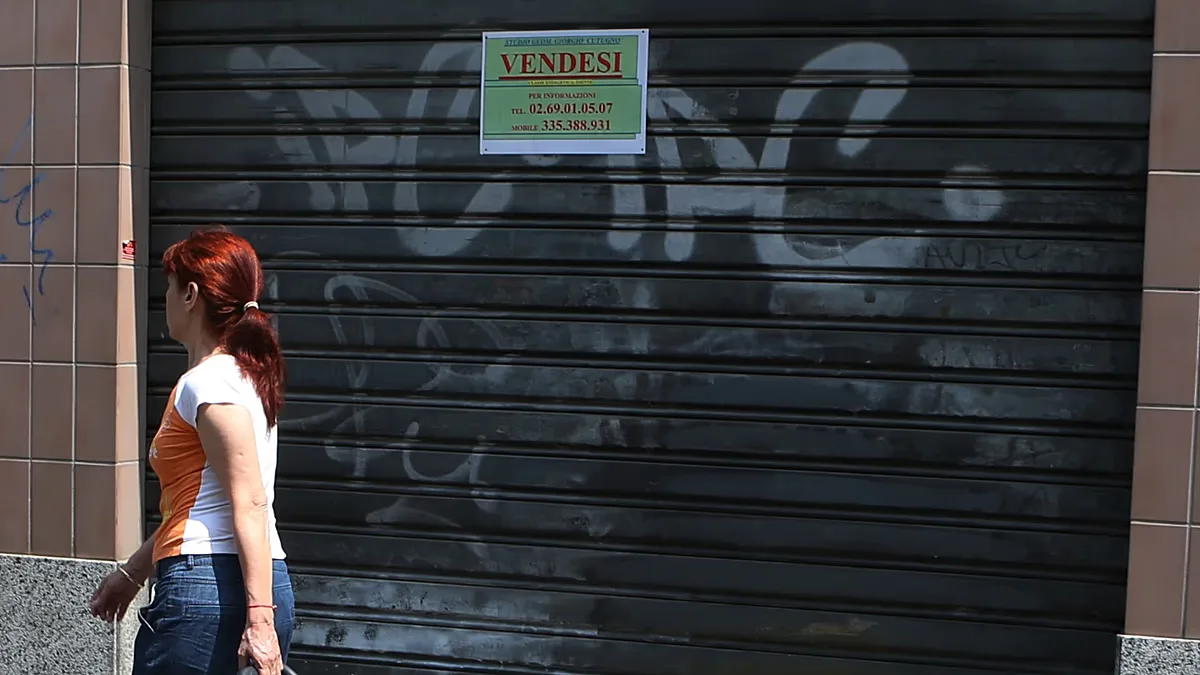
They tend to be smaller units facing onto the street, or sometimes onto an inner courtyard, but they cost less: closed shops are being turned into homes for people in Milan.
Giacomo Oliveri, a 26-year-old engineer, has bought 38 square metres in the south-west of the city centre for €290,000 in a space that used to be a greengrocer's. "I live very comfortably, the area is well served," he told Corriere della Sera (source in Italian) on Saturday, "there's a bakery, a gym, a petrol station. For me it also matters what I find when I step out of the front door."
On the same street, a bar and a tailor's shop have also been converted, in what looks like a desirable low-cost solution for those who cannot afford property prices in a big city like Milan, where prices are often thousands of euros per square metre, nor the mortgages needed to pay for them.
How to turn a shop into a home and what it costs
The need for more affordable housing appears to have collided with the economic crisis, which over the past fifteen years, between subprime mortgages, risks of default for entire countries, Covid and wars, has led to the closure of many retail businesses.
According to figures published by the newspaper, in several areas of Italy's economic capital a commercial space costs roughly half per square metre compared to a flat. Unsurprisingly, the number of properties registered as shops has fallen by 6% in ten years, a trend also explained by changes of use.
However, the rules need to be checked carefully in order to access these low-cost homes. Law 105 of 2024, which converted the "Salva Casa" decree into law, has simplified some changes of use between planning categories and set out several basic habitability conditions.
Among other things, these include a minimum surface area of 20 square metres for one person and 28 square metres for two people, a ceiling height of at least 2.40 metres and other health-related parameters, with further requirements and restrictions left to regional and municipal rules and to individual condominium regulations.
As for the charges, there are so-called "secondary urbanisation" costs, which take into account the difference between how much it costs the municipality to service a dwelling and what the impact of a shop used to be on the city, for example in terms of energy use or waste production.
In Milan this difference is almost always zero, both in the city centre and outside it, because charges for shops are higher than those for homes. The administrative process for changing the use of a property can come to several thousand euros, including municipal fees, land registry duties and fees for specialist technicians, while a small percentage is paid to the municipality on any refurbishment work.
In Rome, by contrast, a supplement is almost always required to be paid to turn a former shop or warehouse into a private home and, in addition to administrative charges, there are restrictions for ground-floor units and for the historic centre.
Of course, what looks like a creative solution born of necessity and the urgency of the housing crisis in Italy, which has also led to further measures in the 2026 budget, comes with the risk that former shops will be turned into tiny flats for a whirlwind rental market.
The situation in the rest of Europe and the risk of speculation
The trend is not limited to large Italian cities. A survey by Confcommercio published last month (source in Italian) estimates over 458,000 to 460,000 vacant commercial premises in Italy, equal to 16.9% of the total stock, mainly small non-food shops.
Among traditional shops, clothing, footwear and homeware stores, beauty salons and hairdressers have abandonment rates above 20%, while travel agencies exceed 34%, with higher rates in southern Italy than in the north. The report concludes that shutters coming down for good would cost Italy more than €4 billion a year.
There is therefore a need to offset this loss by converting these spaces into homes or public areas or by incentivising other commercial businesses. The trend extends to several European countries.
Portugal has simplified by law the conversion of shops, offices and garages into homes to increase the housing supply. The reform has already encouraged some conversions, especially in major cities, attracting investors and owners interested in turning commercial properties into housing. However, many projects run up against technical, building and condominium constraints that limit the number of conversions that can actually be carried out.
In Spain, the conversion of shops, offices and other unused properties into homes has gone from a marginal phenomenon to an increasingly common strategy in cities. According to El País (source in Italian), in the first half of 2025 conversion projects for non-residential properties (offices as well as shops) covering more than 137,000 square metres were launched.
Almost half of these operations are concentrated in Madrid, along with more than 80% of the investment, according to property consultancy CBRE (Coldwell Banker Richard Ellis), with property funds, family offices and specialist investors looking for buildings to upgrade to increase their value. Here too, technical constraints, high costs and complex administrative procedures limit how feasible these projects are.
France and Germany have public policies to convert shops, offices and unused properties
In France, turning non-residential properties into homes is a public policy supported by the state to increase housing supply and bring unused buildings back into use. Conversions mainly involve offices, but also shops, hotels and public facilities, according to a report by Banque des Territoires (source in French), a state body belonging to the Caisse des Dépôts, a public investment authority.
In 2025, the French government introduced new rules to promote these operations and the involvement of private investors, but costs and constraints limit their scope, according to research by the French Housing Ministry (source in French) (the French ministry responsible for housing and construction).
In Germany, converting offices and commercial properties into housing has become one of the tools used to increase the supply of homes. The Federal Ministry for Housing, Urban Development and Building (BMWSB) launched the Gewerbe zu Wohnen (From commercial to residential) programme in 2026, funded with €300 million and grants of up to €30,000 for each new home (source in German) created through a conversion.
The programme is open to both private individuals and investors, with the federal government aiming to bring currently unused buildings and spaces back onto the market (source in German). Here too, projects must comply with technical and energy-efficiency requirements that can make them complex and expensive.
In the United Kingdom, the conversion of offices and commercial properties has been heavily incentivised through Permitted Development Rights, which allow changes of use without a standard planning permission.
The special Class MA category, introduced in 2021 and later expanded by removing some constraints, applies to offices, shops, restaurants, gyms and other commercial premises and has helped create a specialised market of investors and builders.
In London, the phenomenon is so widespread that the Greater London Authority specifically monitors areas where office-to-residential conversions can be restricted. Controls remain in place for aspects such as natural light, noise and housing quality.
According to the UK authorities, these conversions should help increase the supply of homes, although they are not enough on their own to solve the housing shortage, as in other major European cities.



Comments 0
No comments yet. Start the conversation.
Leave a comment