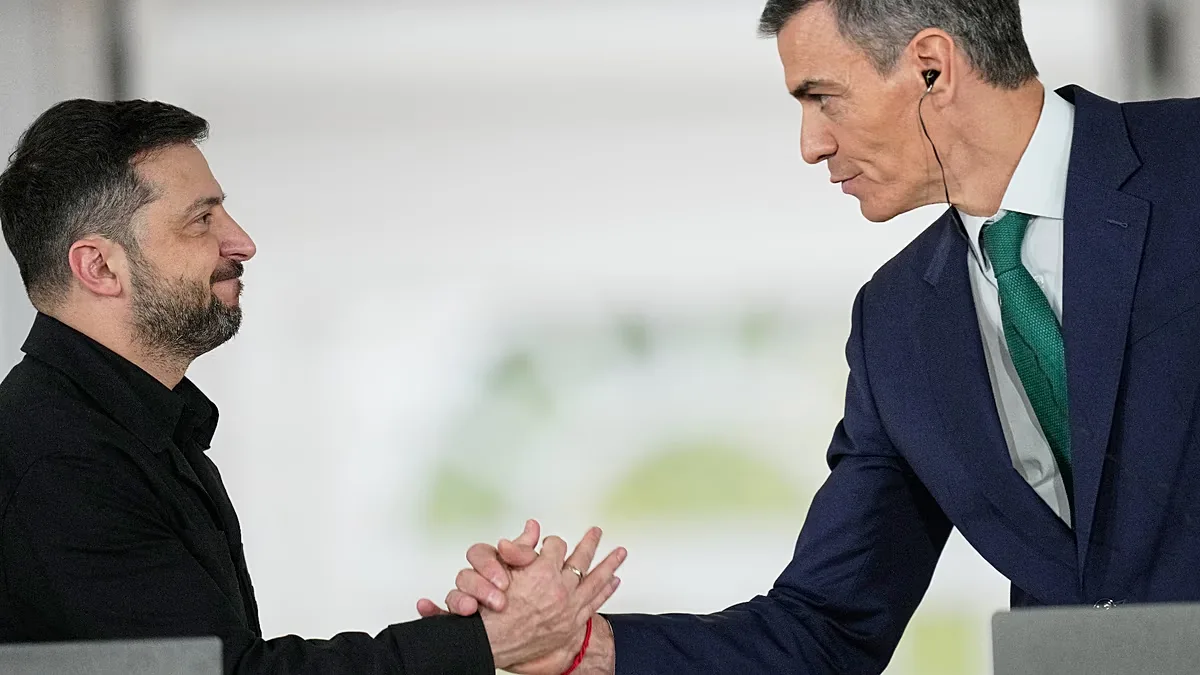
Ukrainian President Volodymyr Zelenskyy arrived in Madrid on Wednesday for a series of high-level meetings coinciding with the Ibero-American Summit. His visit, kept secret for security reasons until his plane landed, includes a schedule of meetings with international leaders over the summit's two days.
Zelenskyy will take part in a meeting on Thursday with several of the leaders who have travelled to the capital, among them UN Secretary-General António Guterres and European Council President António Costa.
The presence of Spanish Prime Minister Pedro Sánchez is also expected, along with other Ibero-American representatives. Besides this meeting, the Ukrainian president will hold bilateral talks with Sánchez and with Spanish King Felipe VI.
Holding the summit in Madrid is also an opportunity for Kyiv to strengthen its contacts with Latin American countries, a region where the war triggered by the Russian invasion continues to generate opposing positions. According to government sources, Zelenskyy plans to hold meetings with representatives of several of the 22 Ibero-American delegations present in the capital.
Zelenskyy to meet country leaders in a heated context
Zelenskyy confirmed his arrival on social media, saying "our top priority is strengthening Ukraine's air defences, protecting our people, and expanding defence cooperation and production."
"Further support steps are being prepared," the Ukrainian president added, without providing details on the measures or the leaders he would meet.
The far-right presidents of Argentina and Chile, Javier Milei and Jose Antonio Kast, as well as Bolivian conservative Rodrigo Paz, are among the Latin American heads of state in the Spanish capital.
Two weeks ago, Milei made a visit to Madrid where he called Sanchez a "disgraceful dictator" and urged Spaniards to "kick out" his Socialists in the election.
The firebrand libertarian has made several unofficial visits to Spain since becoming Argentina's president in 2023, but has never met Sanchez, instead supporting the conservative and far-right opposition as well as launching into long diatribes against socialism.
The Ibero-American format has lost influence in recent years, and reversing that trend is the key goal of the group's 30th summit in Madrid.
At the last summit, held in Ecuador in 2024, a historically low four heads of state turned up and the divided participants failed to adopt a final declaration.
This year, the seven Latin American presidents in attendance will illustrate the region's tilt to the right after a slew of electoral victories for allies of Trump.
Further complicating the scene for Sanchez is the absence of his leftist allies in Latin America's powerhouses: Mexican President Claudia Sheinbaum and Brazil's newly re-elected veteran Luiz Inacio Lula da Silva.
'The best response is an open economy,' Felipe VI
Against a backdrop of economic uncertainty and international tensions, Felipe VI argued for an open economy and a move away from protectionism. "The best response does not lie in protectionism, but in an open economy based on equal rules for everyone," he told Ibero-American business leaders gathered in Madrid.
The Spanish King rejected the idea that the response should be to close off the national economies or raise trade barriers. Instead, he advocated greater openness and cooperation between countries that share values and objectives. In this regard, he highlighted the potential of Ibero-America as a space to deepen ties and generate new economic opportunities.
The region has, he stressed, significant energy resources and strategic raw materials, including critical minerals and rare earths, which could place it in a prominent position in the new international economic landscape. To make the most of these opportunities, Felipe VI stressed the importance of having "stable environments, legal certainty and solid, transparent institutions".
These are conditions he considers essential for attracting investment and building trust. "Trust is one of our most valuable assets and, allow me to say, also one of those we can most easily lose", he said.
Finally, the Monarch stressed the importance of continuing to tighten ties between the European Union and Latin America and the Caribbean, a relationship he sees as essential for tackling today's economic challenges and seizing the opportunities offered by a rapidly changing international landscape.
Albares defends the Ibero-American Summit amid absences
It fell to the Foreign Minister, José Manuel Albares, to play down the empty seats. "It is absolutely not a forum in decline," he insisted on Wednesday before the foreign ministers' meeting. His argument is that all 22 countries have someone in Madrid, at least their foreign minister, and that those who are not coming either rarely travel or are facing internal problems that prevent them from being away for several days.
Absent, among others, are Lula da Silva, Claudia Sheinbaum and Delcy Rodríguez, and with them several of the presidents closest to Sánchez, who instead finds himself alongside Chilean José Antonio Kast and Milei, at the opposite end of the political spectrum. Albares chose to look back. Only three heads of state attended the Cuenca meeting in 2024, and compared with that, ten seems a success to him.
On the ideological clash, the minister said the community had always been diverse in the political colour of its governments and that its strength lay in putting a common voice above differences he regarded as temporary. The Ibero-American Secretary-General, Andrés Allamand, describes it as "the summit of reaffirmation".
Comments 0
No comments yet. Start the conversation.
Leave a comment