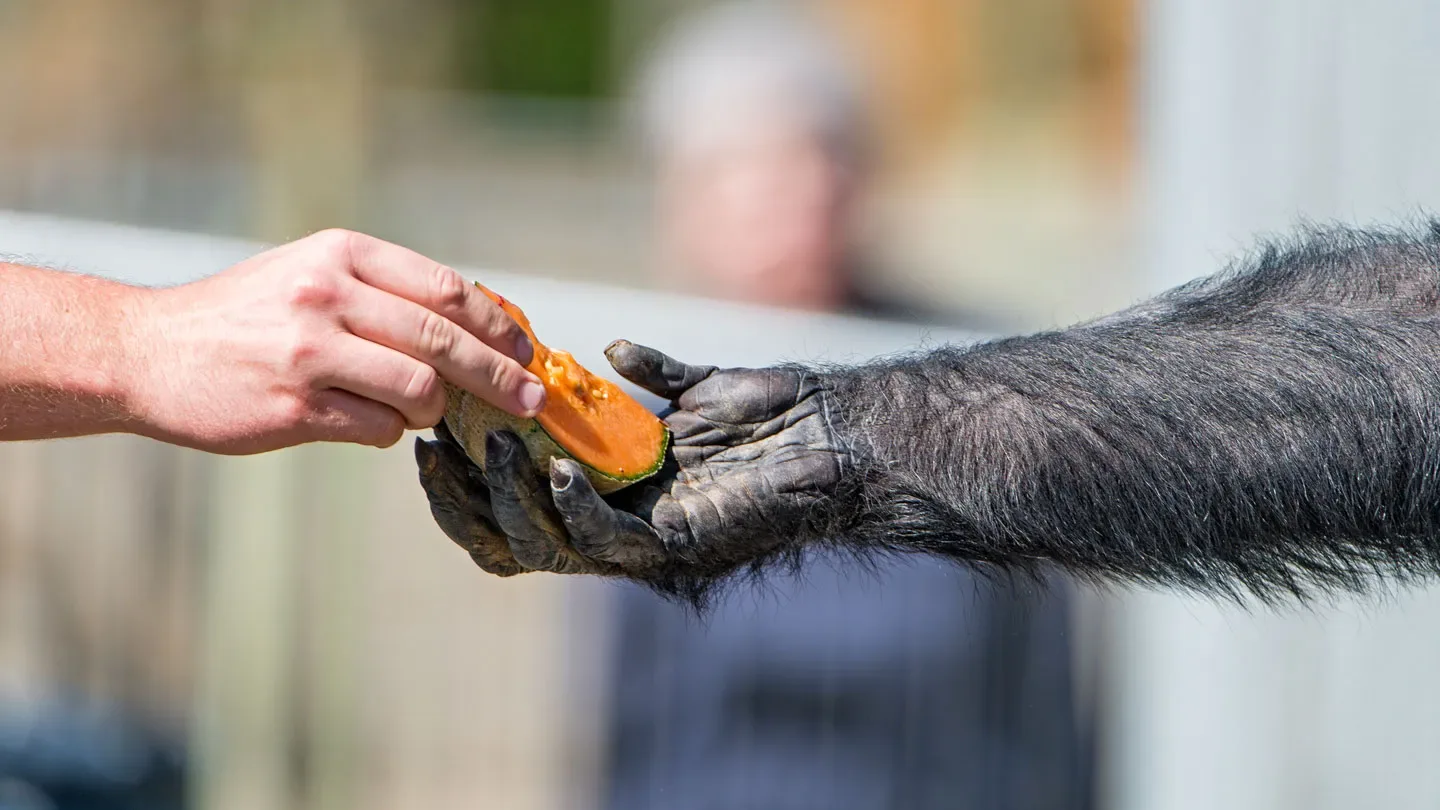
Viruses may be minuscule, but one may have influenced major differences between human and chimpanzee brains.
Millions of years ago, a virus left DNA behind in an African ape's genome, and that genetic material persisted in modern-day chimps. These remnants of past infections appear to influence genes involved in neuron development, which may help explain how human and chimp brains came to differ so greatly, researchers report October 23 in Science Advances.
Compared with the brains of their chimpanzee relatives, human brains are three times larger and more cognitively powerful. Yet "most of their protein-making genes are very similar," says Johan Jakobsson, a neuroscientist at Lund University in Sweden. In the absence of large differences in the genetic code, Jakobsson and his colleagues decided to examine the parts of the human and chimp genome that control when and where genes are turned on or off.
Changes in gene regulation can originate from viruses. Some viruses called retroviruses insert their own DNA into their hosts' genomes to command host cells to build more viruses. But those parasitic bits of DNA can linger long after an infection. If this occurs in reproductive cells, the viral DNA is passed down along with the host's DNA.
These leftover bits, called endogenous retroviruses, no longer code for the production of infectious viruses, but they can have a major impact on the host's biology — especially if they make copies of themselves across the genome. And they have. Such viral remnants make up at least 8 percent of the genomes of humans and chimps alike. More broadly, these DNA leftovers have been linked to some major evolutionary events, such as the evolution of the mammalian placenta.
Jakobsson and his colleagues focused on a particular viral vestige in chimps. The holdover came from an infection in an ancestral African ape somewhere between 5 million and 7 million years ago. In chimpanzees, the viral DNA had inserted itself into the genome at 158 different locations. However, it is curiously absent in humans. Why remains unknown.
The researchers wanted to know how that exact pathogen footprint might affect chimpanzee brains compared with those of humans. Working with chimpanzee stem cells, they removed the viral DNA using CRISPR, a gene editing technology that allows for precise, targeted cuts in DNA. Once the viral DNA was gone, a nearby gene called LINC00662 — normally silenced in chimpanzees — turned on, producing RNA the team could detect. This matches the normal condition in human brain cells, in which LINC00662 is active. The team also used CRISPR to shut off LINC00662 in the human cells, matching the silenced condition seen in chimpanzees.
When LINC00662 was active in chimp or human cells, the researchers noticed activity boosts in other genes that may be important to brain development — such as genes involved in the development and maturation of neurons and in making new neural connections. It's not yet clear exactly how the viral DNA's shutdown of this brain gene network affected the biology of chimpanzee brains. However, this genetic difference may have contributed to a divergence in how human and chimpanzee brains evolved, Jakobsson says. "Our findings show one way an ancient viral [DNA] insertion could create a lasting difference in how a gene is regulated in humans and chimpanzees," Jakobsson says. Other genetic and environmental changes could be involved in the puzzle as well, he says.
Researchers have previously looked to single-letter swaps in DNA to help explain how human and chimp brains diverged in their evolution. But the new study highlights that creatures can accumulate genome changes in other ways, says Giorgia Modenini, an evolutionary biologist at the University of Padua in Italy who was not involved with this research.
The researchers make a convincing case that these particular viral leftovers influence developmental differences between human and chimp neurons, says Ravinder Kanda, an evolutionary geneticist at Oxford Brookes University in Oxford, England. “They’ve proved that absolutely. How far that goes, I don’t think we can quite say yet.” Other controls on gene activity may also be involved, or this particular ancient lever-puller may represent just a sliver of the viral holdovers that have shaped brain development, Kanda says. “I think there are many, many more retroviruses to be discovered, and at the moment we’ve only touched the tip of the iceberg.”


Comments 0
No comments yet. Start the conversation.
Leave a comment