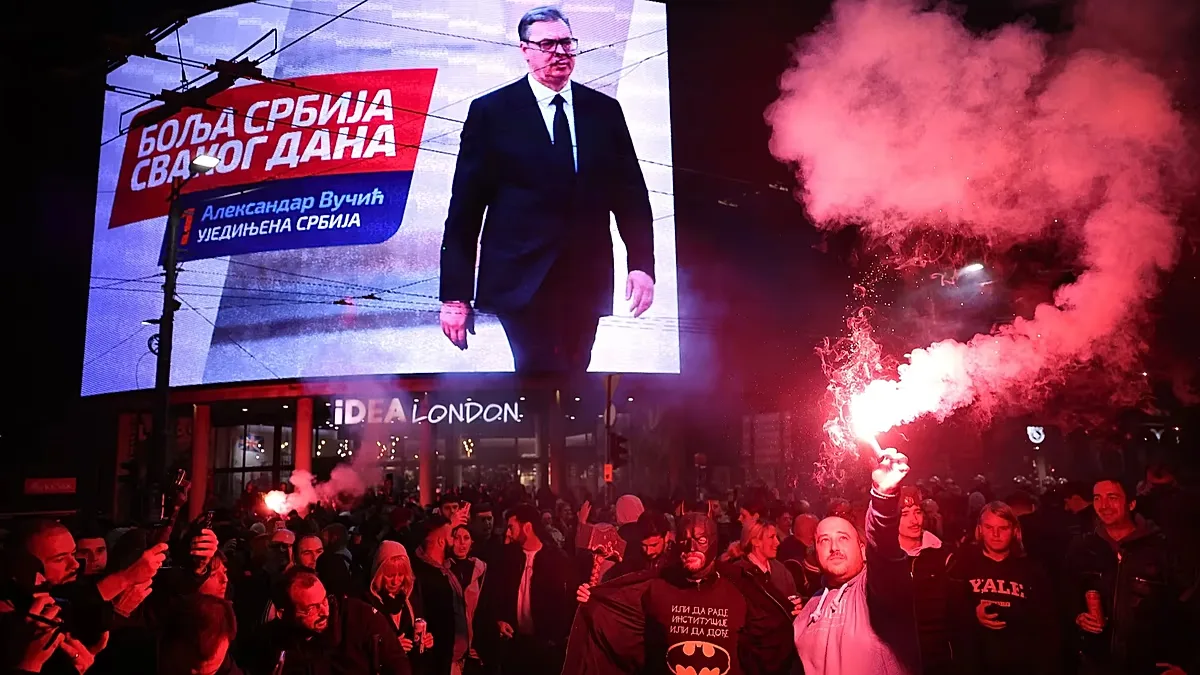
Serbia has entered a new political era. The Student List has won the country's parliamentary election, marking a dramatic breakthrough for a movement that emerged from months of student protests and rapidly transformed itself into the country's most important political force.
In a brief statement to the nation, outgoing Serbian President Aleksandar Vučić conceded defeat and declared that the Student List has won the majority in parliament.
Vučić said that "based on the stratified sample, it is clear that we have lost the election," adding that "the Student List has won and will have between 135 and 140 seats, while we will have around 105."
"No one else has entered parliament. The Alliance of Vojvodina Hungarians (SVM) has won three seats, the Albanians one, and I think the SDA has also secured a seat," he added.
The Serbian Progressive Party received around 1.72 million votes, admitted Vučić. The Student List won 2.2 million, giving it a majority of 52% to 32.3%.
It is still too early to assess the final results and determine whether any other smaller parties have crossed the 3% electoral threshold, but it is clear that this would not affect the final outcome of the election or the identity of the winner.
The result represents far more than a change in the distribution of parliamentary seats. It is a profound rejection of the political model that has dominated Serbia for more than a decade.
From protest movement to political force
The Student List's victory is particularly significant because it was not created as a conventional political party. Its origins lie in the student protests that became a powerful expression of dissatisfaction with the country's political institutions, the government, corruption allegations, media conditions and what many protesters described as a lack of accountability.
What began as a protest movement has therefore achieved something considerably more difficult - it has translated street mobilisation into electoral legitimacy.
The result suggests that the movement managed to attract voters far beyond the university campuses where the protests began. Young people were its most visible supporters, but the electoral coalition appears to have extended to parts of the urban middle class, opposition-minded voters and citizens who had previously been reluctant to support established opposition parties.
A defeat for the old political establishment
For the ruling establishment, the result is a major political setback.
For years, President Aleksandar Vučić and the Serbian Progressive Party dominated Serbian politics through a combination of strong electoral organisation, extensive political influence, control over a large part of the media environment and a highly personalised political strategy centred on Vučić himself.
The election result indicates that this model has reached a critical limit.
What happens next?
The transition from protest movement to government could therefore prove much harder than winning the election for the Student List.
Running a country requires decisions on the economy, foreign policy, relations with the European Union, Kosovo, security, energy, public finances and Serbia's relations with Russia and China. The students will now have to demonstrate that their political legitimacy can be transformed into effective state governance.
What does the result mean for Serbia?
There are several possible consequences.
First, it represents a generational change in Serbian politics. A movement dominated by young people has succeeded in challenging a political establishment that has shaped the country for years.
Second, it could lead to a major institutional reset. The new government is likely to face strong expectations concerning the independence of institutions, the judiciary, corruption, public media and electoral conditions.
Third, Serbia's foreign policy could enter a new phase. The new political leadership will face immediate questions about the country's EU accession process, relations with Brussels and Washington, and its traditionally close relationship with Moscow and Beijing. Whether the Student List seeks a clear pro-European orientation or attempts to maintain a more balanced foreign policy will be closely watched.
Fourth, Aleksandar Vučić's political future becomes uncertain. Even if he remains president, an electoral defeat would fundamentally change the political balance in Serbia. His ability to dominate the political agenda would be significantly reduced, while his party would have to rebuild itself in opposition.
A new political test
The Student List has won the election. But its real political test begins now.
Winning an election requires mobilisation, a powerful message and the ability to unite voters around the desire for change. Governing requires something different: institutions, experienced personnel, economic policy, compromise and the ability to take responsibility for difficult decisions.
For Serbia, the election therefore represents both a political rupture and a moment of uncertainty.
The central question is no longer whether the students can challenge the established political order.
They have already done that.
The question now is whether they can replace it - and what kind of Serbia they intend to build in its place.

Comments 0
No comments yet. Start the conversation.
Leave a comment