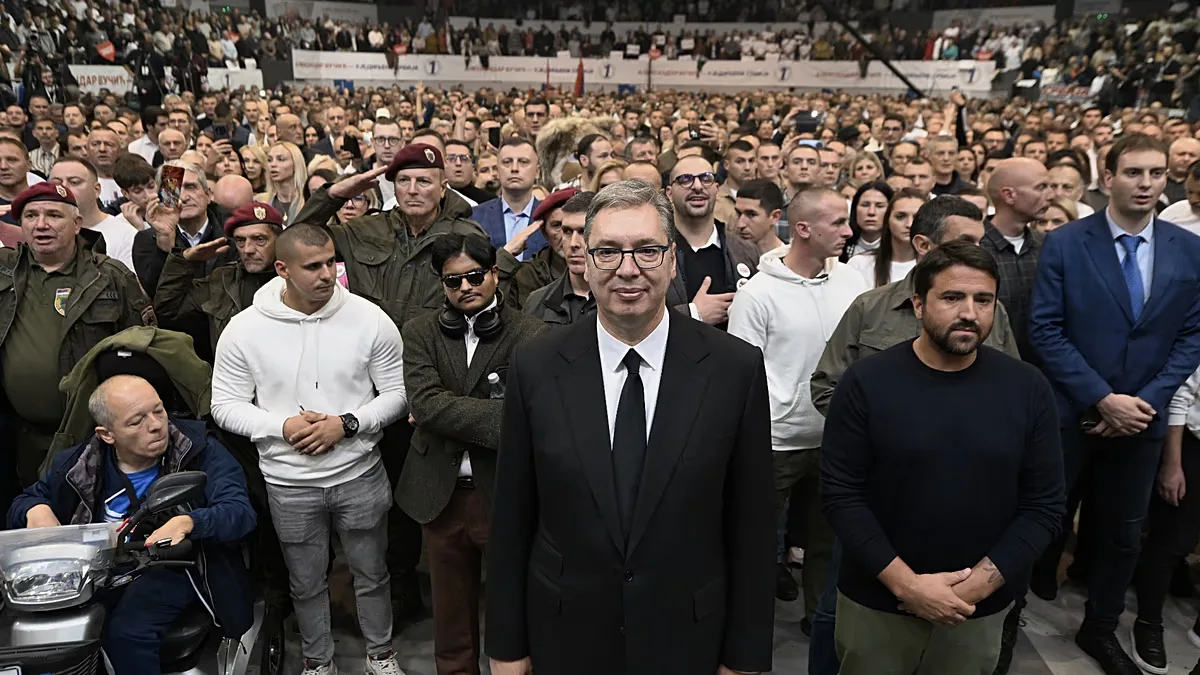
Serbia goes to the polls on Sunday, October 25, for snap parliamentary elections that could mark one of the most important political turning points in the country in more than a decade.
Voters will elect 250 members of the National Assembly, with more than 6.45 million people eligible to vote. Eighteen electoral lists, with a total of 2,418 candidates, are taking part. The elections were called after President Aleksandar Vučić dissolved parliament on September 9, following a proposal by the Serbian government.
However, the political reasons for the early election run much deeper than the constitutional procedure itself. Serbia has been going through a period of intense political and social polarisation for almost two years, beginning after the tragedy at the railway station in Novi Sad on November 1, 2024.
The collapse of a concrete canopy at the station killed 16 people. The student protests that followed initially focused on demands for accountability and the publication of documents related to the station's reconstruction, but gradually developed into a broader movement against what they describe as corruption, a lack of political responsibility and the way state institutions function.
During 2025, students organised mass protests, university blockades, blockades of institutions and roads, as well as rallies across Serbia. The movement gradually expanded beyond student issues and became the strongest challenge yet to Aleksandar Vučić's government, whose rule had not been seriously challenged for a full 14 years. In May 2025, students called for snap parliamentary elections, and during 2026 they decided to take part in the elections with their own list.
This fundamentally changed the character of the election. What was supposed to be another parliamentary contest has become, in many ways, a referendum on Vučić's political dominance and the political system that has been in place in Serbia for more than a decade.
Who is taking part in the election?
The largest political bloc is built around the Serbian Progressive Party, running under the electoral list "Aleksandar Vučić – United Serbia." Although Vučić is no longer president of Serbia, he remains the central figure of the campaign. In late September, he resigned from the presidency in order to lead the SNS (Serbian Progressive Party) campaign and run for the position of prime minister, a position he had already held before becoming President of the Republic. This has further turned the election into a direct vote on his political future.
The list "Ivica Dačić – Stability Factor" is also taking part, bringing together the Socialist Party of Serbia and smaller parties. An important part of the political spectrum consists of right-wing and nationalist-oriented lists, including "Authentic Right – Miloš Jovanović – Boldly Serbian," and the pro-European opposition centre is represented by the list "European Serbia." Participants in the election include the minority Alliance of Vojvodina Hungarians, the SDA of Sandžak, Usama Zukorlić's list, the Albanian Coalition and several smaller parties and movements, which, in the event of a close result, could play an important role in forming the new government.
The most distinctive participant is the Student List – "Students Win." It is not a conventional political party and does not have a traditional party leader. Candidates were selected through student plenums, and the list includes professors, doctors, artists, activists and other people who have generally not held senior political positions. The list has 250 candidates and represents an attempt to transform the protest movement into a parliamentary political force.
Why are tensions in Serbian society so high?
The fundamental problem is no longer simply the relationship between the government and the opposition. At the centre of the conflict is the question of trust in institutions.
For many protesters, the Novi Sad tragedy became a symbol of a much wider problem: corruption, political accountability, public procurement, institutional control and the relationship between the government and its critics. The authorities, meanwhile, describe the protests as an attempt to destabilise the country and bring to power a movement lacking sufficient political experience. Government officials further claim that "foreign actors" stand behind the student movement, while President Vučić has repeatedly said foreign intelligence services are financing a "colour revolution" in Serbia.
Two fundamentally different narratives have thus emerged. The government stresses stability, economic development, national interests and the danger of foreign interference. The student movement focuses on accountability, the fight against corruption, the rule of law and the independence of institutions from political influence.
What has changed compared with previous elections?
The biggest change is the disappearance of the traditional opposition as the ruling party's main challenger. In the 2023 election, opposition parties grouped around the "Serbia Against Violence" coalition won around 24% of the vote and 65 parliamentary seats. Subsequent fragmentation and internal disputes, however, weakened their position. In the meantime, the student movement has taken over much of the political energy and voter support that previously belonged to the traditional opposition.
As a result, the main political dividing line is now much simpler: the ruling SNS and Vučić versus the Student List, while other parties are fighting to enter parliament and secure the role of potential coalition partners. Voter turnout becomes a particularly interesting factor here, as does which parties clear the 3% electoral threshold. The election outcome could ultimately hinge on these seemingly minor technicalities.
What are the main political trends in Serbia?
The most important trend is that Serbia's political system is undergoing a major transformation. The student movement is the first major social movement in many years to successfully move beyond traditional opposition parties and attract large numbers of people who had previously been politically inactive.
At the same time, the SNS still has a very strong party infrastructure, a large network of local organisations and a stable core of voters. This means the outcome is far from predetermined. Opinion polls have produced different forecasts, and because of the changing political landscape and the large number of undecided voters, the result is difficult to predict with precision.
Another important trend is the continued polarisation of Serbian society. The country is divided not only over the government and the opposition, but also over identity, Serbia's relationship with the European Union, Russia and the West, national issues and the country's future foreign-policy orientation.
A third trend concerns European integration. Serbia remains a candidate for EU membership, but its European path has been slowed by problems involving the rule of law, its relations with Russia and its limited alignment with parts of the EU's common foreign policy, as well as the stalled normalisation process with Kosovo. At the same time, Belgrade continues to maintain close relations with both Russia and China.
If the SNS wins, Vučić will seek to form a new government and stabilise the political system after almost two years of protests. If the Student List wins enough seats to form a government alone or with its allies, Serbia could enter an entirely new political era. And if the result is close or disputed, there is a real possibility that the political crisis will continue even after the polls close.
For all these reasons, this election is not simply an election for a new parliament. It is a test of the survival of the political model that has dominated Serbia for more than a decade — and a test of whether a new, non-party movement can change that model.
Comments 0
No comments yet. Start the conversation.
Leave a comment