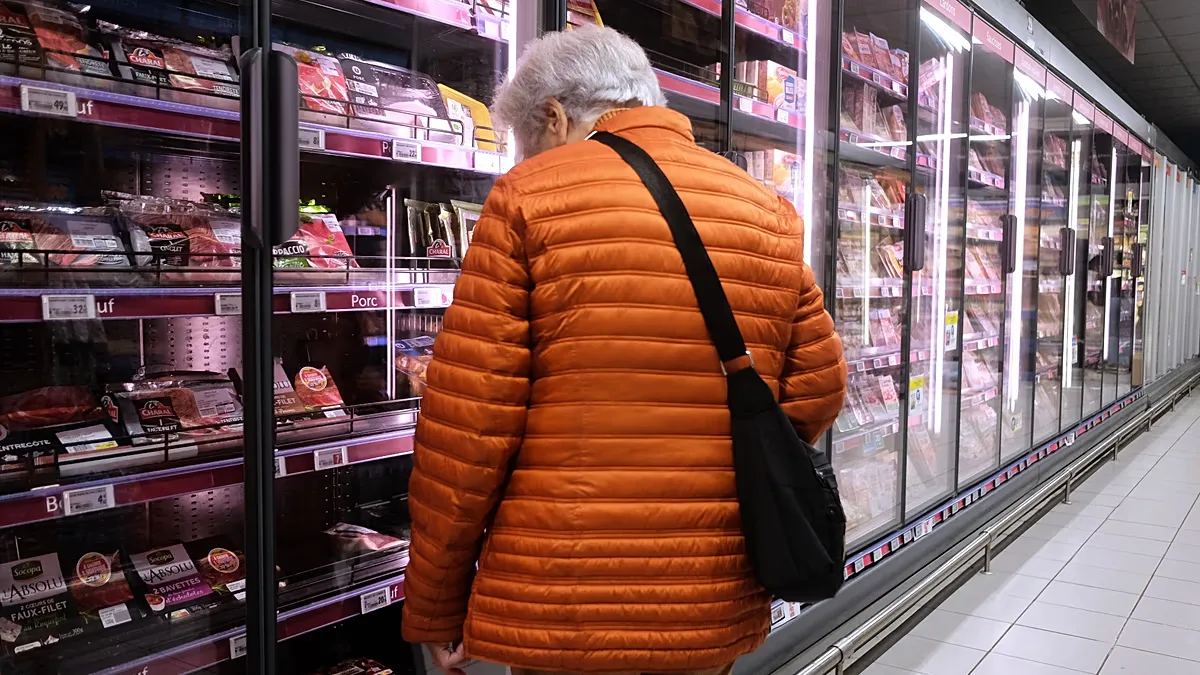
'Shrinkflation' happens when manufacturers reduce the weight, volume or quantity of their products while keeping prices unchanged.
"[Shoppers] purchase the same product in the same packaging, but will buy less for the same price," said Loïc de Hults, a senior associate at law firm CMS Belgium.
The practice is not new, but has become more common in Europe since the 2022 inflation surge. In 2019, a French syrup maker reduced its bottles from 750ml to 600ml, with consumer group Foodwatch later reporting a price increase of more than 37% per litre. In Germany, a brand reduced its chocolate bars from 100g to 90g, prompting a court ruling against the company in May 2026. Another one also introduced smaller 75g chocolate bars in 2026, compared to its usual 100g format.
According to a 2025 European Commission report, 74% of consumers have noticed products getting smaller without becoming cheaper.
The reason is rising production costs. "Some manufacturers have been looking at reducing the packaging and the quantities to maintain prices, instead of increasing them," said Christel Delberghe, director general of EuroCommerce, which represents European retailers and wholesalers.
"Cost increases are being passed on through the chain overall," added Leena Whittaker, EuroCommerce's director of competitiveness. "If the costs of energy, inputs, production, and processing increase [...], prices will go up."
Consumer groups are calling for tougher rules, and countries including France and Austria have introduced measures requiring supermarkets to flag smaller products. But the EU has no specific law against shrinkflation, relying instead on broader rules against misleading business practices.
Same packaging, less product
Manufacturers have several ways to reduce product sizes, from leaving empty space in bags to using thicker packaging or raised bottoms. The strategy plays on a psychological blind spot: reductions of just 5% to 7% can go unnoticed. Some companies also advertise a "new recipe" or "improved quality" without drawing attention to changes in quantity.
Shoppers should watch for changes in net weight, fewer items in multipacks or unusually large packaging compared to what's inside. Checking the price per kilogram or litre on supermarket shelf labels also helps compare products.
Should there be laws against shrinkflation?
Food and non-alcoholic drink prices across the EU rose by roughly 33% between 2021 and 2025. But the EU has not introduced rules specifically targeting shrinkflation; EU law requires food packaging to display net quantity, and supermarkets to show prices per kilogram or litre. The Unfair Commercial Practices Directive only bans 'misleading practices'.
De Hults believes these EU laws already offer some protection.
"There is already a general prohibition of misleading practice. And in in Germany, for instance, the court of [Hamburg] considered that reducing the volume of a product and keeping the same packaging without correctly informing the consumer is a misleading practice. So, this is already covered by European law," he said.
Still, he acknowledged that shoppers may not immediately notice when a familiar product gets smaller: "If it's something that [they're] buying weekly, the first time that they will buy the new product, they will obviously not notice unless they're really reading all the labelling on the products," he said.
The issue reached the European Parliament. On 15 July 2025, its Internal Market and Consumer Protection Committee held a public hearing where lawmakers examined how practices like shrinkflation and dynamic pricing affect shoppers, leading to a question to the Commission about whether existing consumer laws were enough to tackle shrinkflation.
The Commission defended current rules, pointing to mandatory weight labels and unit prices as ways for consumers to identify price increases. It said national authorities must enforce the law and promised to continue monitoring the market.
National regulations?
In March 2025, the Commission opened proceedings against Italy after it introduced rules for manufacturers to put warning labels on products that had shrunk. Brussels argued that these labels could create barriers to trade between EU countries and suggested notices on supermarket shelves instead.
Other European countries have their own rules. Since July 2024, French supermarkets larger than 400 square metres must warn shoppers when products shrink but their price per kilogram or litre increases. Stores must show the old and new quantities, along with the price increase, for two months, or risk fines of up to €15,000.
Austria introduced similar rules in April 2026, requiring larger supermarkets and health and beauty shops to flag products that shrink while their unit price rises by at least 3%.
Romania also introduced mandatory notices in 2024, while Belgium has discussed similar legislation but has yet to adopt specific rules.
Competition between supermarket chains also affects how much shoppers pay, as retailers compete on prices and negotiate with suppliers. Differences between countries are not always what shoppers might expect: Eurostat figures for 2024 put food prices 18% above the EU average in France, compared with 7% in Belgium.
De Hults warned that different national rules could complicate matters for manufacturers selling products across Europe: “If we are speaking about packaging, it has to be regulated at EU level. Otherwise, it will be too complicated for the manufacturers,” he said.
Common EU rules would help companies understand what they can and cannot do, particularly as more countries introduce their own requirements: “Specific rules at EU level would be good just so that everybody knows what they can do in every country”, he added.
EuroCommerce, however, believes the existing legislation is enough. “Adding yet another layer of regulation will not necessarily change much in relation to consumers, but it will certainly add some more regulatory burdens, and cost, and reporting obligations, and uncertainty on the retailers,” said Delberghe.




Comments 0
No comments yet. Start the conversation.
Leave a comment