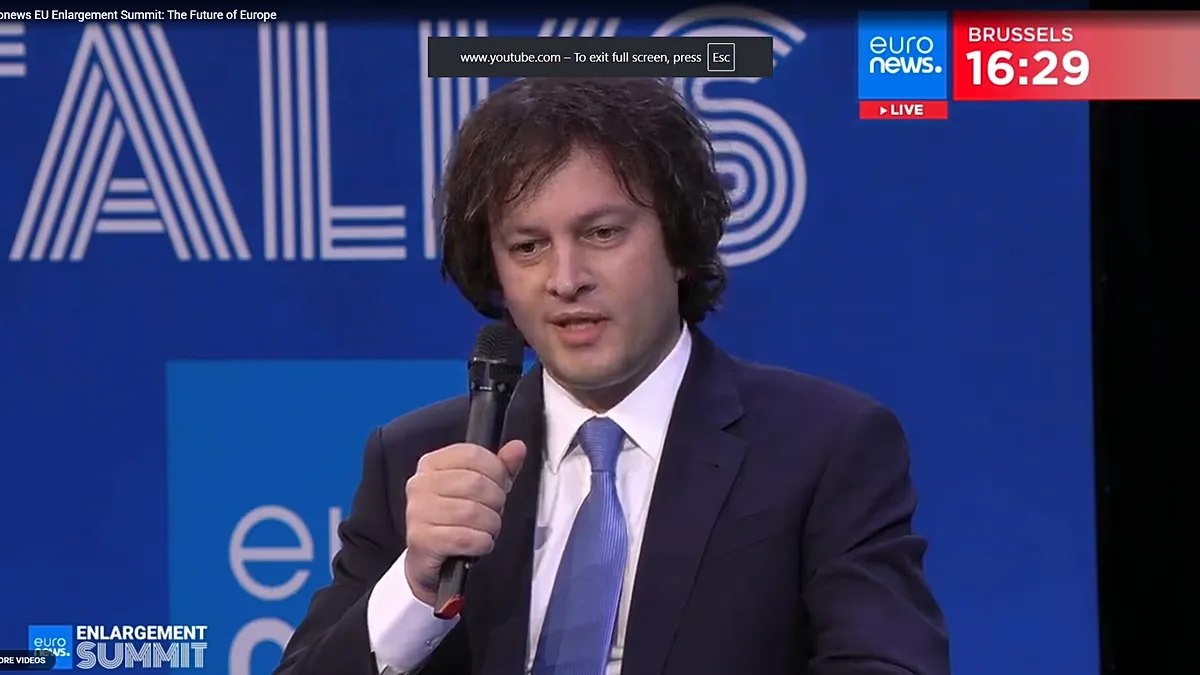
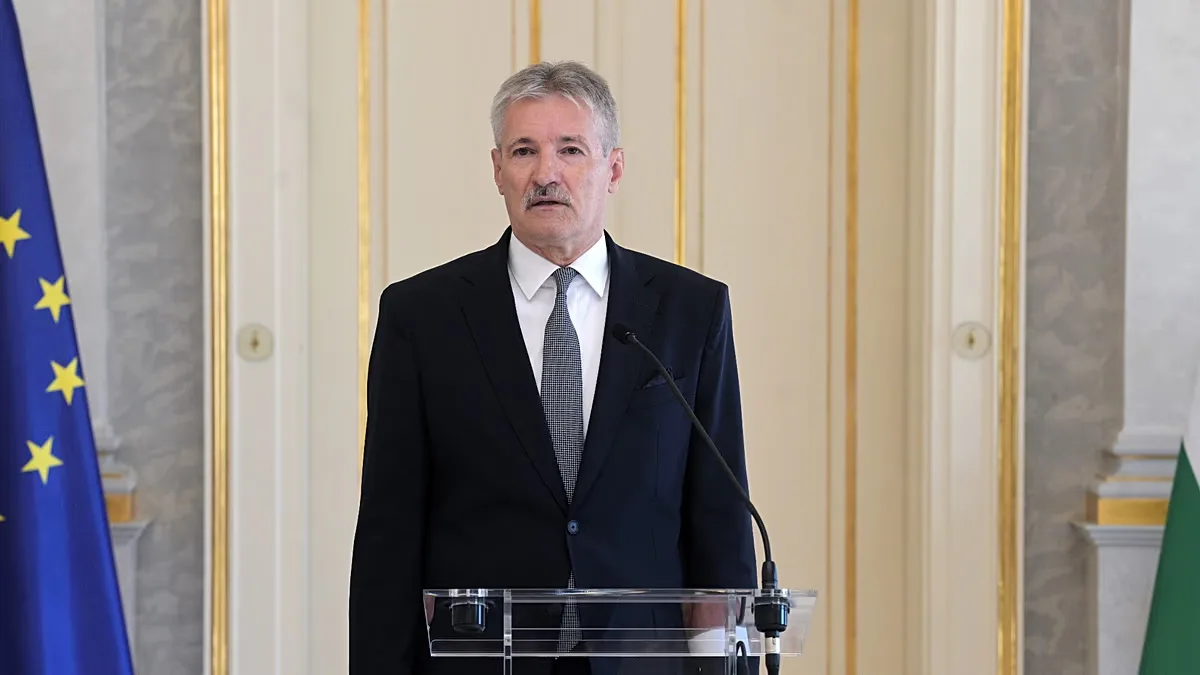
Georgian Prime Minister Irakli Kobakhidze insisted his government remains "very committed" to joining the European Union but offered no convincing explanation of how he intends to revive the country's stalled accession bid, instead accusing Brussels of political "blackmail".
Speaking at the Euronews Enlargement Summit on Tuesday, Kobakhidze repeatedly blamed the European Commission for the breakdown in relations, while refusing to reconsider the controversial laws that helped bring Georgia's EU ambitions to a standstill.
Georgia applied to join the bloc in 2022 alongside Ukraine and Moldova, following Russia's full-scale invasion of Ukraine. But the Commission initially withheld candidate status, citing insufficient progress on democracy, the rule of law and institutional reforms.
"It was a great mistake," he said of the Commission's move.
"It was extremely unclear because there was no ground for that. The European Commission publicised its assessment, its scores about Georgia and other countries, and Georgia was doing much better than Moldova or Bosnia. But these countries received candidate status."
He accused the Commission of political bias, claiming its decision had fuelled protests organised by opposition groups and NGOs that he alleged were funded by European and other foreign donors.
Georgia eventually received candidate status in December 2023, but relations deteriorated rapidly. Within months, the European Council concluded that the government's actions had effectively halted the accession process.
In November 2024, Tbilisi announced it would not seek to open accession negotiations before the end of 2028 in a unilateral move after the European Commission published a report indicating serious democratic backsliding from the judiciary to media freedom.
Asked why his government had taken that decision despite nearly 80% of Georgians supporting EU membership, Kobakhidze again shifted responsibility to Brussels.
"If the European Commission decides to open the accession talks for Georgia, we would immediately join. It was not us. But of course, the European Commission, which decided to suspend the political dialogue with Georgia," Kobakhidze said.
"When somebody wants to change anything in Georgia, they should talk with us. But now the problem is that they don't talk with us. They are not ready for talking with us," he said.
Pressed on what concrete steps he would take to break the deadlock, Kobakhidze offered little beyond a willingness to hold a public discussion with the Commission.
He maintained that Brussels' assessment of Georgia was false and amounted to political blackmail.
Crucially, he ruled out repealing either of the two laws at the heart of the dispute: legislation on the transparency of foreign influence and a national registry of NGOs, both criticised by the Council of Europe's Venice Commission, which urged the ruling party to reconsider the legislation in two separate instances.
The Venice Commission said in a legal opinion that the goals were not clear, some definitions vague, and criminal penalties disproportionate.
Kobakhidze argued that demanding their repeal violated Georgia's sovereignty.
"The Parliament of Georgia, with dignity, passed the legislation, which is fully in line with international standards," he continued, accusing the Venice Commission of political bias as well.
He went further, likening Brussels' demands to the Soviet era, when Georgia was obliged to follow directives from Moscow.
"We want to have a different approach with Europe," he said.
Throughout the interview, Kobakhidze accused the Commission of double standards, political interference and refusing to engage with Tbilisi. Yet he offered no clear route out of the impasse, nor any indication that his government was prepared to address the EU's central concerns.
Asked why Georgia still wanted to join the EU, he replied that he is “optimistic” that the EU will change, not only in its attitude towards Georgia but as a Union as a whole, given the growing geopolitical challenges and economic headwinds it faces.
“We have to agree with each other, the European Union and Georgia, that we want to see a democratic rule of law-based, human-rights based, economically strong and sovereign Georgia in the European Union. If they agree on this, everything will go on,” he said.
The reports by the European Commission have been endorsed by the European Council, representing the 27 leaders that must unanimously agree to a candidate's entry to the EU. In a Council resolution in 2025, EU leaders urged Georgian authorities to end their hostile rhetoric against EU institutions and the EU mission in Tbilisi.
Comments 0
No comments yet. Start the conversation.
Leave a comment