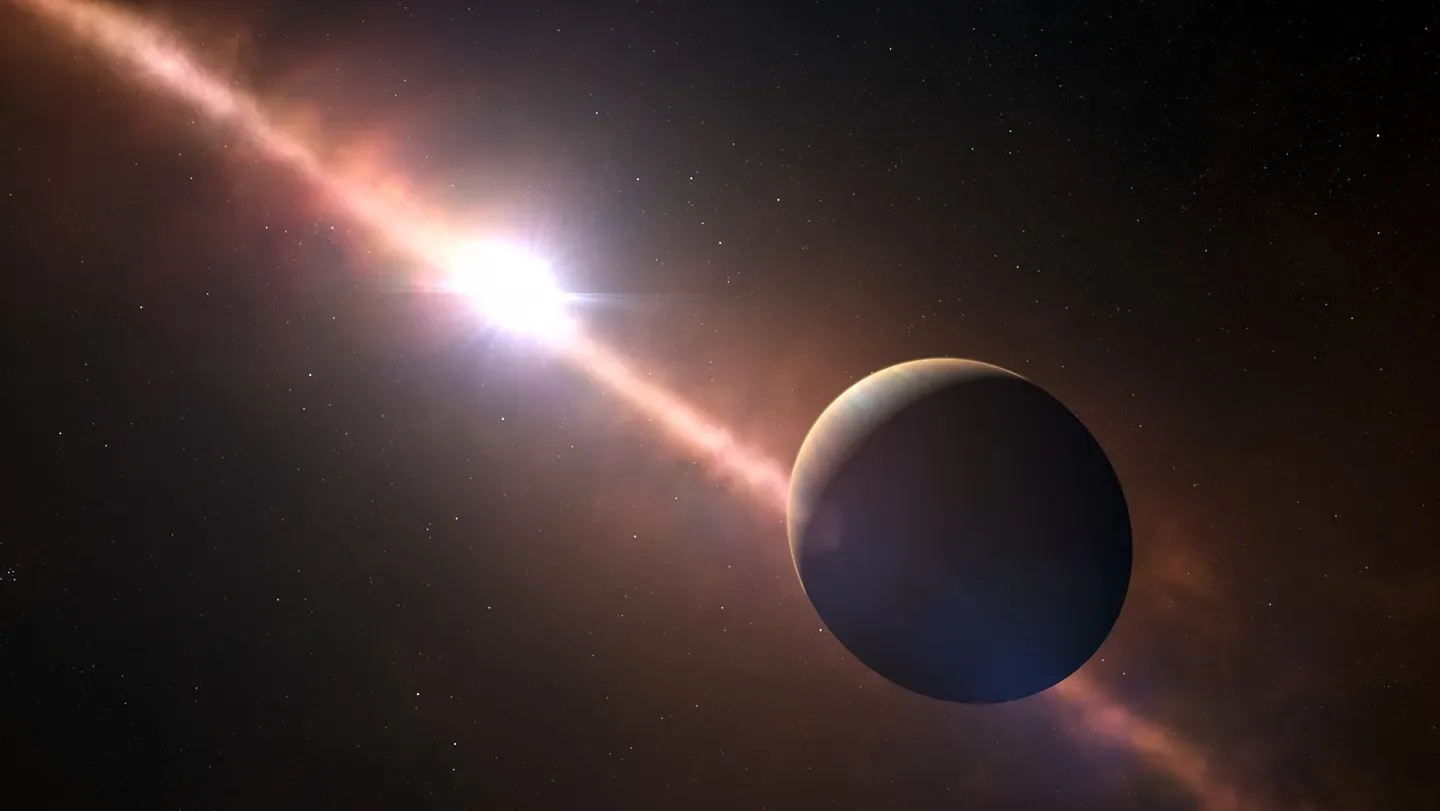
For the first time, scientists have spotted radio waves from an exoplanet.
Astronomer Yvette Cendes knows what you're thinking: "When people see 'radio signal from an exoplanet,' they think aliens," she says. But, sorry — it's not aliens.
Instead, it could be the first clear evidence of an aurora on a planet outside the solar system, Cendes and colleagues report in a paper submitted September 15 to arXiv.org. The radio waves also reveal the planet's magnetic field, making this potentially the first direct detection of the magnetic field of an exoplanet.
"This result, if it holds up in peer review, is an incredibly exciting advancement," says astronomer Joe Callingham of the University of Amsterdam, who was not involved with the research. "It would be a fantastic result."Using the MeerKAT radio telescope in South Africa, scientists observed radio waves from Beta Pictoris b, a gas giant orbiting a young star about 63 light-years away. Importantly, the researchers were able to trace those radio waves to the exoplanet itself, rather than the star that it orbits. "We can rule out the star, and … we can say that it's from this one particular planet," says Cendes, of the University of Oregon in Eugene. That's been a major hurdle for previous efforts to find radio waves from exoplanets.
Auroras are the source of Earth's northern lights, and they also occur on other planets in the solar system, including Saturn, Jupiter and Mars. They're caused by electrically charged particles circling in a planet's magnetic field, exciting molecules in the atmosphere that generate the glow. As the charged particles circle, they emit radio waves. Auroras emit radio waves that are circularly polarized, which means that the orientation of the waves rotates in a circle. And that's what the researchers saw from Beta Pictoris b.
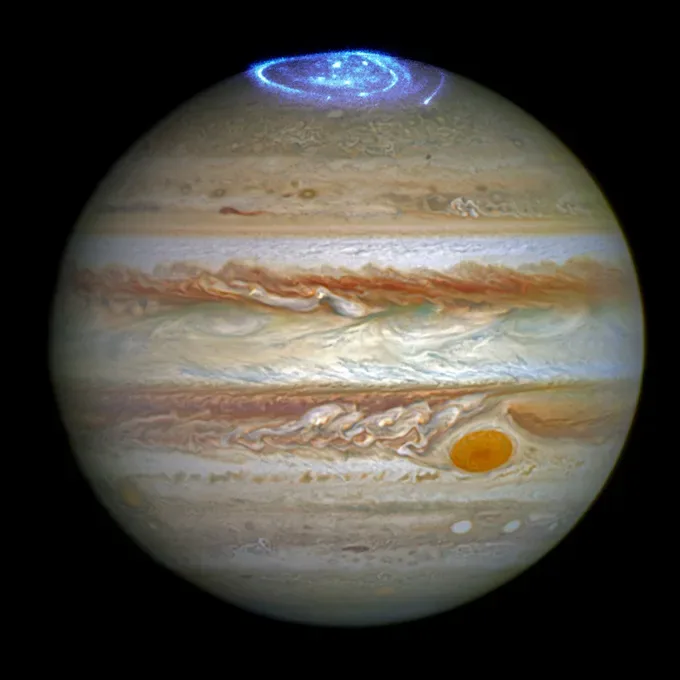
Because auroras depend on magnetic fields, measuring the radio waves from them can reveal information about the planet's magnetic field. Beta Pictoris b, the researchers found, has a magnetic field of more than 1,000 gauss — a common unit of magnetism. Earth's magnetic field is tiny in comparison, about half a gauss. "It's an incredibly, incredibly strong magnetic field, much stronger than anything in our solar system," Cendes says.
That's not surprising for a large planet like Beta Pictoris b, which has a mass 10 times that of Jupiter. Its large mass means it's close in size to brown dwarfs, which are in a class of their own — too big to be planets and too small to be stars. Scientists have previously seen auroras on brown dwarfs, which indicate magnetic fields of thousands of gauss. So, such a whopping magnetic field on a large planet is not unexpected.
To really clinch the case for an aurora on an exoplanet, Callingham says, you'd want to see the radio waves pulsate in time. That's because the aurora should rotate in and out of view as the planet spins — roughly once every eight hours for Beta Pictoris b. "So TBD, but, compelling," Callingham says. "It's probably auroral."




Comments 0
No comments yet. Start the conversation.
Leave a comment