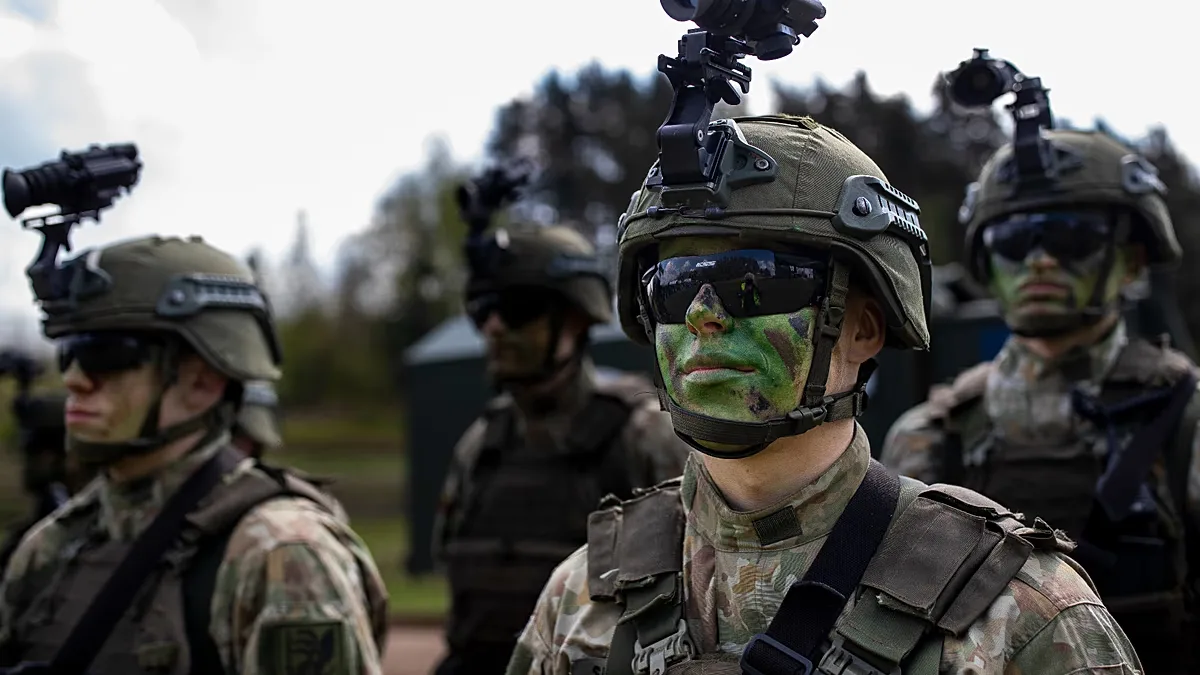
The European Commission has opened a new round of low-interest defence loans and is urging member states to spend them on joint ventures with Ukraine, as Kyiv faces a €70bn budget gap.
On Thursday, €21.3bn of unspent funding under the Security Action for Europe (SAFE), the EU’s financing programme for strategic defence investment, was made available, with the Commission hoping to steer some of it towards Ukraine.
“Using the remaining funds from SAFE, we will be setting up a new programme for joint projects with Ukrainian companies,” Commission President Ursula von der Leyen said in her annual State of the Union address to the European Parliament last month.
SAFE was created to help EU countries urgently boost their defence capabilities and industrial output in response to Russia’s war of aggression against Ukraine and growing doubts over US security guarantees during Donald Trump’s second term.
Several member states, most notably Italy, Hungary and France, borrowed far less than anticipated. That left a pot of unspent money, which the Commission has now reopened through a second round of calls running until 13 November.
In a letter to European governments on Thursday, Defence Commissioner Andrius Kubilius encouraged member states to deepen cooperation with Ukraine through joint ventures, notably in the areas of most urgent need: missile defence systems, drones and ammunition.
“We are definitely encouraging our member states to do whatever they can to do joint projects at the moment,” Commission defence spokesperson Thomas Regnier said. “These leftovers can definitely benefit national defence industries, but also Ukraine in the current context. We can align both interests.”
Ukraine’s government is indeed facing a massive budget shortfall as damaging airstrikes continue. But the EU executive has no way of forcing member states to involve Ukrainian companies, since the loans are theirs, taken out for their own defence.
Naturally, EU countries would rather spend their defence budgets boosting national players. Still, there are some reasons for optimism in Brussels that Ukraine could get at least part of the €21.3bn.
Until May, SAFE rules allowed governments to place single-country procurement orders. In theory, this was a temporary derogation to accommodate urgent national purchases.
In practice, it was introduced at the insistence of Polish Budget Commissioner Piotr Serafin, precisely to keep as much money as possible for Polish companies. Warsaw has earmarked 89% of its funding for the Polish arms industry.
Poland is by far the largest SAFE beneficiary, with €43.73bn, nearly 30% of the total. It is expected to seek even more, but this time it cannot do so under the single-country procurement procedure.
The Commission therefore hopes that Poland and other countries applying for more SAFE loans will involve Ukraine so as to meet the multi-country procurement requirements, even though there is no minimum share set for the second country.
“In the current situation, the Commission cannot just say: do whatever you want with it. But there is no guarantee that this will happen,” an EU official told Euronews on condition of anonymity.
There is also the question of whether member states can absorb the entire sum. Besides the countries that borrowed less, some eastern flank members, such as Romania, are already under an excessive deficit procedure for overspending.
Eight EU countries never joined SAFE, including Germany and the Netherlands, which can borrow more cheaply on their own than through common EU debt. That leaves only a few member states, such as Poland, Ireland and Greece, likely to want new loans.
That opens a realistic prospect of several billion euros going unspent just as Ukraine is in dire financial need. The current regulation does not allow unused loans to be reallocated to Kyiv directly, but it would not be the first time Brussels explores “creative solutions.”
Comments 0
No comments yet. Start the conversation.
Leave a comment