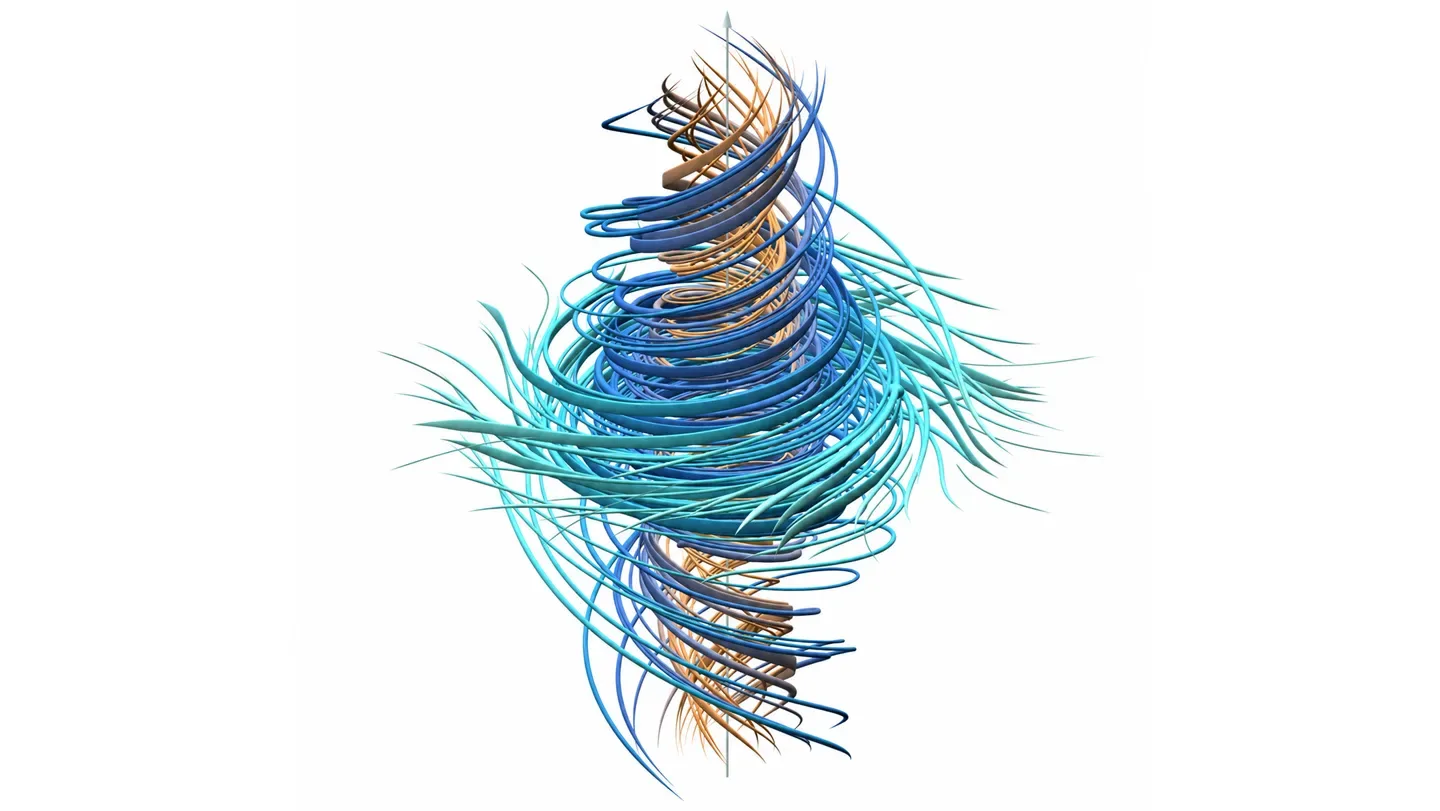
The movement of fluids looks simple, but the equations that govern it lie at the center of one of mathematics’ most famous open problems. That problem now appears to have been resolved with help from AI, though the achievement arrived amid intense controversy.
OpenAI announced on September 8 a solution to the Navier–Stokes existence and smoothness problem, a problem so consequential that a $1 million prize has been offered for solving it. “It’s one of the guiding problems for the field. It is a huge deal to know the answer,” says mathematician Dallas Albritton of the University of Wisconsin–Madison, who was not involved in the new work.
The previous day, two mathematicians had reported progress on a closely related problem. Tristan Buckmaster of New York University and Levent Alpöge of Anthropic, an AI company, drew on help from various AI models, including OpenAI’s. The relationship between the two advances—and whether OpenAI had access to the pair’s progress—has been the subject of intense speculation.
The Navier-Stokes equations describe relationships among pressure, density and velocity of a fluid as they change over time. The equations are foundational to science and engineering, relevant for weather forecasting, ocean-current studies and the design of aircraft, pumps, turbines and more. “It’s an incredibly important, ubiquitous set of equations,” Albritton says.
Although the equations date to the 19th century, they are not fully understood—in particular, it has not been clear whether they always behave well. There might be situations in which the equations break down, producing physically impossible outcomes such as fluid flowing at infinite speed, known as “blowups.” Determining whether the equations are naughty or nice is one of seven challenges selected in 2000 by the Clay Mathematics Institute as the Millennium Prize Problems, each carrying a $1 million bounty.
Buckmaster and Alpöge focused on a set of equations called the Euler (pronounced like “oiler”) equations. Whereas the Navier-Stokes equations include viscosity—a term describing a fluid’s resistance to flow—the Euler equations do not, making them a stepping stone to the more famous problem. The pair found a blowup when an outside force pushes on the fluid, solving what is called the forced Euler problem. As the pair refined their results, rumors about their work began to circulate. Spurred by those vague rumors, OpenAI researchers began tackling the various Millennium Prize Problems and quickly focused on Navier-Stokes, using around 10,000 AI agents at a time.
The agents found a solution to the forced version of the Navier-Stokes problem: a vortex that grows skinnier and faster until its speed goes to infinity. That means the Navier-Stokes equations are not always well-behaved, answering the long-standing question. Running so many AI agents cost millions of dollars, OpenAI researchers estimated. (OpenAI stated in a blog post that it will not claim the Millennium Prize.)
OpenAI’s solution has been confirmed by Lean, a tool that allows verification of complicated mathematical proofs. But because the paper reporting the result is 166 pages long, mathematicians are still digesting it. “I don’t think anyone has completely verified the proof yet, certainly not on the human side,” says mathematical physicist Gregory Eyink of Johns Hopkins University.
The achievements are part of a wave of AI results deluging mathematics. Over the past year, AI has enabled major leaps, leaving mathematicians grappling with rapid changes to their field. The new result, on one of mathematics’ most important problems, is “the spectacular culmination of the arc we have seen over the last 12 months,” OpenAI researcher Sébastien Bubeck said during a September 8 news conference.
In a statement published on his website on September 7 along with the forced Euler solution, Buckmaster said his team’s results mark a “Deep Blue-Kasparov moment,” referring to the 1990s milestone when a supercomputer defeated the best human chess player. “The community needs to have serious and unhurried discussion about where to go from here,” he said.
Mathematicians are certainly taking notice. Albritton learned of Buckmaster and Alpöge’s result around 1 a.m., while awake with his newborn baby. He stayed up until 6 a.m. discussing it with colleagues.
Despite the problem’s mathematical clout, its solution will not have significant practical implications, Eyink says. The Navier-Stokes equations describe fluid as a continuum, but real-world fluids are made of individual molecules and atoms, so it is already known that there is a cutoff where the equations no longer apply. It is more about prestige, Eyink says. “There’s a huge mathematical celebrity associated with these equations.”
That also raises concerns about how credit for a discovery is distributed. After initial rumors began circulating, Buckmaster says he had a series of discussions with OpenAI researchers about how to present the two results. Those discussions, he alleged, involved a request to exclude his coauthor Alpöge, who works for OpenAI competitor Anthropic. Buckmaster’s account also raised questions about whether the AI agents had access to Buckmaster and Alpöge’s progress. OpenAI denies that its AI agents had direct access, but says, “while unlikely, we cannot rule out that de-identified data derived from their usage of our products helped improve our models.”
The biggest implication of the advance may be the issues it raises about the difficulty of attributing credit when AI is involved, Eyink says. “This is, for me, the really serious ongoing problem and issue that has to be resolved.”



Comments 0
No comments yet. Start the conversation.
Leave a comment