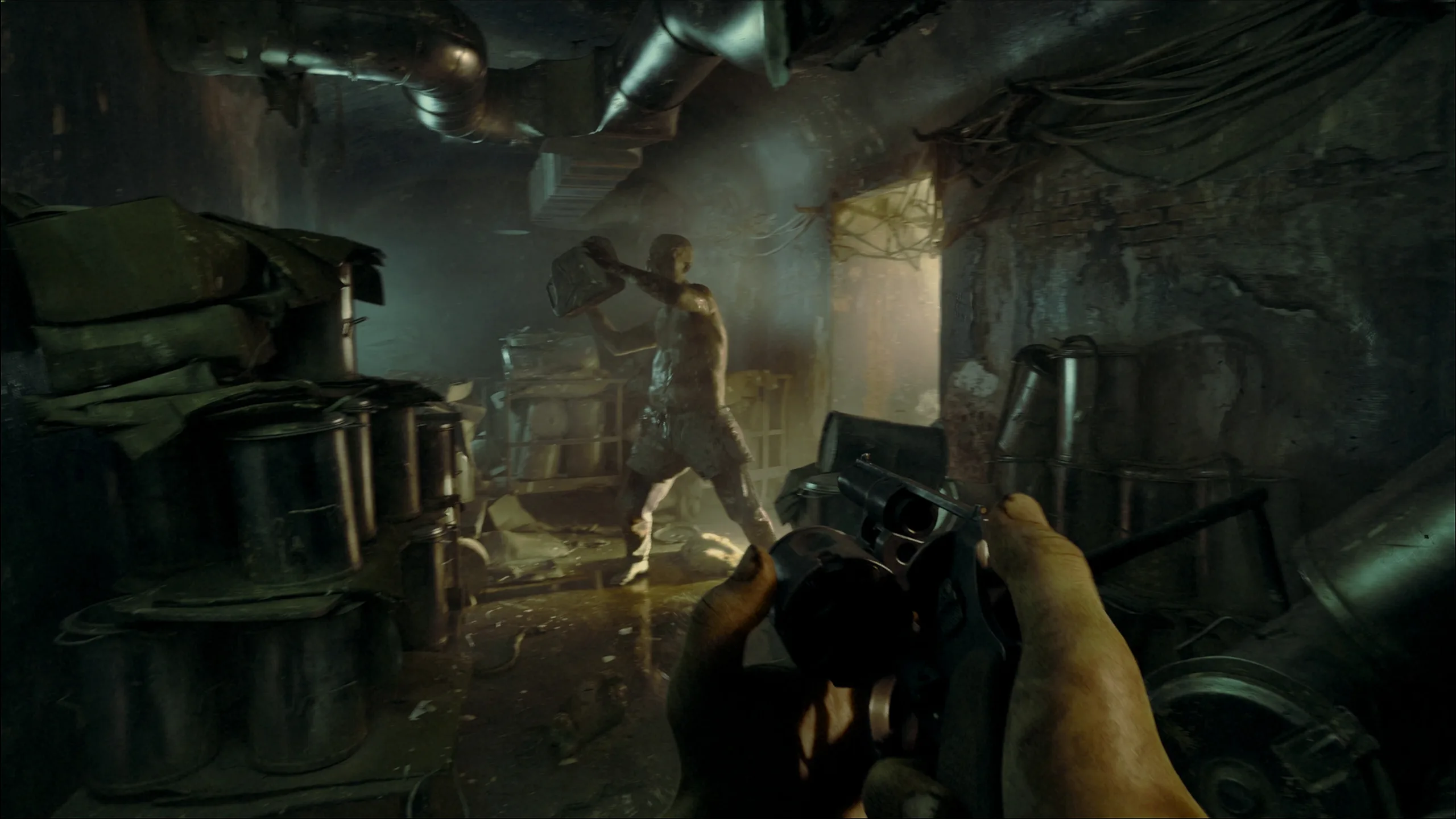
Developed by Team Clout, this first-person survival horror project made its presence felt during the 2025 showcase season with a disturbing vision of a research fortress overtaken by something monstrous. Dismemberment and reactive physics are central to that vision, promising encounters in which pulling the trigger does not necessarily restore control.
The most intriguing question is whether those elements can sustain more than an impressive trailer. Beneath the spectacle lies a potentially more unsettling experience: a desperate personal journey through a place where neither the environment nor the human body behaves as it should.
From Horror Filmmaking to Interactive Terror
Team Clout’s background helps explain the project’s cinematic ambitions. Members of the studio have worked on horror films and television productions, bringing experience in creature design, movement, and visual storytelling to the game. Their approach emphasizes not simply how a monster looks, but how it occupies a scene and unsettles the person watching it.
Translating that knowledge into a game presents a different challenge. A filmmaker can determine exactly when an audience sees a creature. A game must account for someone looking in the wrong direction, hesitating at a doorway, or approaching an encounter in an unexpected way. The monster has to remain convincing when the player interrupts the intended scene.
The project was introduced as the first title under Mundfish Powerhouse, the support initiative established by Atomic Heart developer Mundfish. That relationship is distinct from Mundfish developing the game itself: Team Clout is the creative studio behind ILL, while Powerhouse provides production expertise and support.
For a project with such demanding visual and technical ambitions, that support matters. Designing a horrifying creature is one achievement. Making it interact convincingly with weapons, objects, and the player is another.
A Fortress Built Around a Personal Nightmare
The central premise places the protagonist inside a vast research fort overwhelmed by a mysterious force and the creatures it produces. His objective is personal: he is trying to save what matters most to him, rather than setting out as a conventional hero tasked with rescuing the world.
The supplied commentary describes the location as having an Eastern European character, somewhere between a decaying prison and a scientific facility. That combination gives the setting an immediate tension. Research suggests an attempt to understand or control something; imprisonment suggests that whatever was discovered may never have been safe.
The personal motivation is equally important. A dangerous place becomes more compelling when the protagonist has a reason to enter it that outweighs the obvious reasons to leave. Survival is no longer simply about reaching the exit. It becomes a question of how much someone is prepared to endure before abandoning the purpose that brought them there.
The material leaves the specifics unresolved. Who or what the protagonist hopes to save—and how his story connects to the horrors inside the fortress—remains the mystery around which its interpretation of the game is built.
Survival Means More Than Accurate Shooting
The gameplay described in the commentary combines limited ammunition with crafting, repairs, inventory decisions, and the possibility of weapon malfunctions. Its underlying idea is straightforward: carrying a gun should offer a chance of survival, not a guarantee of safety.
The official description supports that broader emphasis on preparation. Weapons require attention to defects, modifications, and upgrades, while inventory management and item creation are presented as important parts of staying alive. Combat is intended to involve more than aiming accurately at whatever moves.
The potential tension comes from how those demands overlap. A powerful weapon becomes less reassuring when its condition is uncertain. Carrying extra supplies means sacrificing space for something else. Spending ammunition to resolve an immediate threat may leave the next encounter considerably more dangerous.
For these systems to work, their consequences need to feel understandable. A malfunction can produce a frightening moment, but repeated failures without clear warning could become irritating rather than tense. The distinction will depend on how effectively the game teaches players to assess risk.
At its best, this approach could make preparation part of the horror. The uneasy decision would begin before an enemy appears: whether to enter another room with the equipment currently available.
Dismemberment as a Mechanic, Not Just a Spectacle
The most conspicuous part of ILL is its treatment of bodily destruction. Official material presents dismemberment alongside enemies whose behavior can change in response to the player’s actions and their surroundings. The intention is to make violence interactive rather than merely decorative.
The supplied commentary goes further, describing creatures that might stumble, scream, or become more dangerous after losing a limb. It also raises the possibility that destroying one threat could produce another. Those specific outcomes should be treated as claims made by the commentary, rather than guarantees about every encounter in the finished game.
Even with that distinction, the design possibility is compelling. A visible injury would not necessarily mean that the situation had become safer. It might change the problem instead of solving it.
That would give dismemberment a purpose beyond shock value. Players would need to observe what an attack actually accomplished, rather than assuming that enough damage always produces the same predictable result. The fear would come partly from uncertainty about what remained capable of moving.
The challenge is maintaining that uncertainty without making combat arbitrary. Monsters can surprise the player, but their reactions still need enough consistency for observation and judgment to matter.
A World That Bears the Marks of a Fight
The source describes encounters that disturb the room around them: barrels topple, furniture breaks, and an initially quiet space becomes the visible aftermath of a struggle. Official material likewise identifies physics as an active gameplay system, affecting environmental interaction, enemy behavior, and puzzles.
The important possibility is not unlimited destruction. It is the sense that an encounter has physically happened somewhere.
A room that looks different after a fight can reinforce both the violence and its cost. The scattered objects become evidence of where the player retreated, where an enemy charged, and how little control either side had over the confrontation.
That aftermath could also provide a valuable change of pace. Once the noise stops, the player has a moment to recognize what survival required. Silence would not simply separate one encounter from another; it could make the previous encounter feel more exhausting.
Whether these effects become meaningful mechanics or remain mostly visual flourishes will be an important distinction. Reactive scenery is impressive, but it becomes substantially more interesting when it changes the decisions available during a fight.
Being Armed Is Not the Same as Being Safe
The emphasis on gunplay does not mean ILL is intended to remain an uninterrupted shooting gallery. Team Clout has discussed alternating armed encounters with sections in which players lack weapons, using that contrast to preserve vulnerability.
The supplied commentary frames those moments around stealth and avoidance. Their purpose is not difficult to understand: removing a familiar means of protection changes how the player reads the environment.
A corridor that previously looked like a firing lane becomes somewhere to cross without attracting attention. A sound that once suggested a target becomes a reason to stop moving.
However, vulnerability should not depend entirely on confiscating equipment. The more interesting ambition is making the player uneasy even while armed. Limited resources, uncertain enemy reactions, and threatening surroundings could allow the gun to remain useful without letting it become reassuring.
That balance would give the quieter sections more value. Rather than creating fear from nothing, they could intensify anxiety that the combat never fully resolves.
Visual Realism in Service of Dread
The supplied material identifies Unreal Engine 5 as the foundation for the game’s visuals and describes an environment of soaked concrete, reflective floors, unreliable lighting, and dense shadows. Its monsters retain enough distorted human anatomy to make their unfamiliar forms especially uncomfortable.
The comparison proposed in the commentary—somewhere between The Thing and Resident Evil 7—is useful as a description of tone, rather than a claim that ILL will reproduce either experience. The attraction is the collision between recognizable surroundings and bodies that no longer follow recognizable rules.
For that approach to remain frightening, visual detail needs a purpose beyond demonstrating technical capability. Darkness should affect what players can judge. Animation should communicate both danger and physical vulnerability. A creature’s movement should make its anatomy more disturbing, not merely display it from another angle.
Team Clout’s own explanation emphasizes believable spaces and human emotional responses, with immersion taking priority over brutality alone. That is a more promising objective than simply trying to put more gore on screen.
Sound That Makes Empty Space Feel Occupied
Binaural audio is another advertised part of ILL’s horror design, intended to heighten the impact of its creatures and their distressing sounds.
The commentary imagines that soundscape through close breathing, rattling metal, distant screams, and spent casings striking the floor. These details suggest a world in which listening could become as uncomfortable as looking.
The strongest possibility is not simply louder or more startling audio. It is uncertainty about a sound’s source. Something heard behind a wall can make that wall feel less protective. Breathing in the darkness can imply proximity before the player has enough information to judge the threat.
Restraint will matter as much as intensity. Constant screaming can become familiar. A faint, isolated sound after a violent encounter may be more effective because the player has room to interpret it.
Used carefully, the soundscape could make apparently empty rooms feel occupied long before anything steps into view.
What Does “ILL” Really Mean?
The title invites speculation, and the supplied commentary offers several possibilities. Perhaps the protagonist is infected. Perhaps the person he hopes to rescue has already begun to change. Perhaps the fortress housed research intended to cure disease or regenerate damaged tissue, only for that work to produce something uncontrollable.
It also proposes a connection to older biological experiments, drawing that theory from the setting’s perceived Eastern European atmosphere. None of these explanations is established by the supplied material. They are possible readings, not revealed plot details.
Their appeal comes from the same underlying fear: the possibility that the distinction between survivor and monster is less secure than it first appears.
An infected protagonist would make the danger internal as well as external. An infected loved one would complicate the meaning of rescue. A failed attempt at healing would turn the pursuit of bodily security into the source of bodily horror.
The commentary’s prediction of a tragic ending belongs in that speculative category too. It fits the tone being described, but a bleak atmosphere does not establish the outcome of a story.
What matters more than any particular twist is whether the personal stakes give the violence emotional meaning. A disturbing revelation would need characters worth caring about, not just another unsettling transformation.
The Challenge Beyond an Impressive Trailer
The enthusiasm captured in the source rests on a striking combination of creature design, physical interaction, and cinematic presentation. Yet those same ambitions create the project’s most important unanswered questions.
Performance is one. Detailed environments, reactive objects, elaborate animation, and changing enemy behavior need to work together without undermining responsiveness. A struggle against a monster should not become a struggle against inconsistent controls.
Pacing is another. A succession of increasingly gruesome encounters could eventually make the grotesque feel routine. The game will need space for anticipation, exploration, and uncertainty if its most violent moments are to retain their impact.
Finally, there is the question of depth. Dismemberment and physics could support encounters that develop in unexpected ways, or they could become impressive effects attached to otherwise familiar battles. The finished experience will need to demonstrate how those systems interact over time.
The comparisons raised in the commentary—with Dead Space, Silent Hill 2, and Resident Evil 4—express the scale of its hopes. They are not a verdict that the available material can support.
Release Information: An Update to the Original Commentary
The supplied script names PC, PlayStation 5, and Xbox Series X|S as the intended platforms, consistent with the project’s 2025 coverage.
Its statement that there is no release date needs a separate update: as checked on September 15, 2026, the official Steam page lists a planned release in 2027, without an exact day or month. That is a release window, not evidence that the game’s final quality or performance can already be assessed.
Final Thoughts
The most promising idea in the supplied material is not simply that ILL might be exceptionally gruesome. It is that violence might fail to provide the comfort players usually expect from it.
An injured creature could remain dangerous. A weapon could demand attention at the worst possible moment. A survived encounter could leave the protagonist less prepared for whatever waits beyond the next door. Combined with a personal reason to continue, those pressures could give the horror something more durable than immediate shock.
For now, that remains a compelling possibility rather than a demonstrated achievement. The project’s ambitions are clear; the sustained experience still has to prove itself.
If Team Clout can make its atmosphere, physical systems, and emotional stakes reinforce one another, ILL could become more than a showcase for disturbing imagery. Its lasting impression might come from the moment after the gunfire stops—when the room is quiet, the ammunition is lower, and moving forward feels no safer than before.
Comments 0
No comments yet. Add a thoughtful first response.
Log in to comment