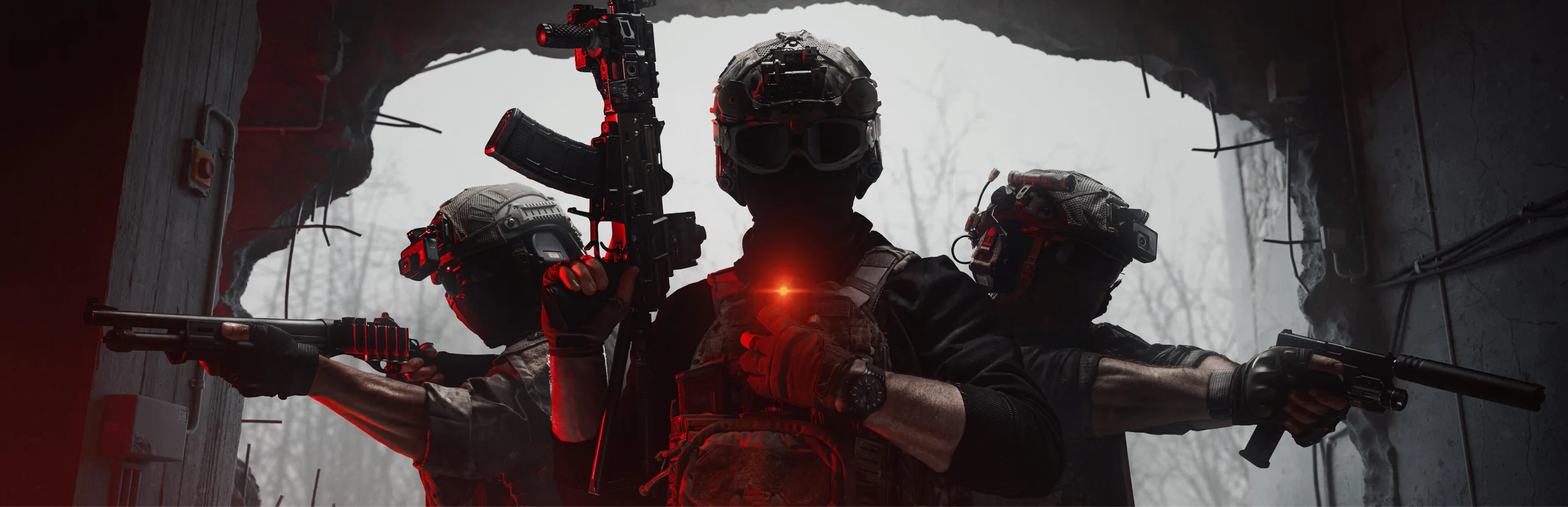
The entire experience is built around the perspective of a body-mounted camera. Weapons move independently of the player’s view, the camera shakes and distorts with motion, muzzle flashes can overwhelm the image, dark rooms become genuinely difficult to read, and gunfire is so violent that a sustained exchange can drown out almost everything else. Put the visuals and sound together and Bodycam can occasionally resemble footage from an actual combat recording rather than a multiplayer shooter.
That visual identity was initially almost all the game had. When Bodycam first appeared in Early Access, content was sparse and the project felt closer to a technical showcase than a complete multiplayer experience. According to the supplied material, a major September update changed that impression considerably, expanding the game enough for its underlying strengths to become much easier to appreciate.
What is surprising is that beneath all the photorealistic presentation sits an unusually straightforward multiplayer shooter. There is no story campaign, no sprawling progression structure constantly demanding attention, and no elaborate seasonal treadmill. You choose a mode, search for a match, and start shooting. Team Deathmatch, free-for-all, Gun Game, and several additional modes form the core of the experience, while a separate 2v2 competitive mode is tied more directly to skill ranking.
That simplicity is one of Bodycam’s greatest strengths.
Modern multiplayer shooters frequently build entire ecosystems around themselves: battle passes, limited-time events, cosmetic stores, daily objectives, constantly shifting metas, and movement systems that reward increasingly elaborate combinations of slides, dives, and jumps. Bodycam feels almost old-fashioned by comparison. Its loop is immediate. Equip a weapon, enter a match, shoot people, earn currency, buy additional guns or attachments, and repeat.
Attachments are handled in an unusually player-friendly way. Purchasing a compatible accessory once makes it available across other weapons that can use it, rather than forcing the same purchase repeatedly. It is a small decision, but one that contributes to the sense that the game wants the shooting itself to remain the focus.
More importantly, Bodycam refuses to play like a movement shooter.
The character feels heavy. Turning, aiming, and repositioning carry noticeable inertia. You cannot simply explode around a corner at full speed, snap onto a target, and expect the game to reward the maneuver. The weapon moves before the character’s head fully follows, creating a separation between aim and camera that takes time to understand. Slow movement, pre-aiming, and carefully checking angles are usually more reliable than rushing into a room.
At first this can feel uncomfortable, even clumsy. Eventually it becomes obvious that discomfort is not an accidental by-product of the presentation. It is the central design principle.
Realism Through Deliberate Discomfort
Almost every system in Bodycam works against the effortless precision players are accustomed to in competitive shooters.
Hip firing is unreliable beyond extremely close range. Iron sights can be difficult to use because recoil and muzzle flash obscure the target. Tactical aiming provides another option, but loses much of its usefulness at longer distances. The game constantly introduces small imperfections between the player’s intention and the virtual body carrying it out.
Ordinarily, that sounds like a recipe for frustration. The difference is that everyone is fighting against the same limitations.
There is less room for a single overwhelmingly dominant approach when players can die after only one or two accurate hits and practically every firearm is dangerous in the right circumstances. The result shifts attention away from discovering an obvious meta weapon and toward positioning, timing, and surviving the chaos long enough to land a clean shot.
The reload animations are perhaps the best example of the game’s philosophy.
The supplied review describes several informal levels of stress. Under calm conditions, a character reloads relatively efficiently. Under pressure, the hands may begin to fumble: a magazine misses the well, the bolt is not operated cleanly, or the process simply takes longer. Under extreme stress, bolt-action rifles become especially awkward, with characters struggling to manipulate the weapon correctly.
These are not merely amusing animation details. They can directly affect whether the player survives the next few seconds.
A failed reload in most shooters is usually the player’s fault. In Bodycam, the character’s panic becomes part of the event. You may know exactly what you want to do while watching the hands on screen momentarily fail to cooperate. During a close-range duel, those seconds feel enormous.
Even prolonged automatic fire carries physical consequences. The character can become visibly tired, at times removing a hand from the weapon and shaking it out after a long burst. Again, it sounds irritating in isolation. In motion, these details combine into something unusually convincing: the avatar no longer feels like a perfectly responsive camera floating through space. It feels like a frightened person attempting to operate a firearm under pressure.
The audio design pushes the same idea much further.
Gunshots are extraordinarily aggressive. A full magazine fired indoors can leave the soundscape overwhelmed for several seconds, making communication difficult. There is no convenient separate slider that simply reduces firearm volume while leaving everything else untouched; lowering the overall intensity means lowering the entire game.
More impressive is how gunfire behaves inside different spaces. The source describes sound scattering through rooms, blast energy escaping through windows, and pressure traveling down corridors. Whether standing in a narrow hallway or a larger interior, the acoustic response contributes heavily to the illusion that the weapon actually exists inside that space rather than merely playing a loud sample next to the camera.
Then there are the smaller details.
During a match, the character may physically adjust the body camera. A hand covers part of the image while the microphone picks up the noise of being touched. The interruption lasts only a couple of seconds, and it can happen at inconvenient moments, but removing it would also remove part of what makes Bodycam recognizable.
This is the strange contradiction at the center of the game: many of its most memorable features are things a conventional competitive shooter would probably remove in the name of responsiveness.
Bodycam keeps them because the friction is the identity.
Maps That Turn the Same Mechanics into Horror
The bodycam presentation would be little more than a visual gimmick if the environments did not support it. Fortunately, several of the maps are particularly effective at exploiting the game’s style.
The modern trench-warfare map is the clearest example. Burned woodland, collapsed trenches, muddy terrain, and a body-mounted perspective combine into an atmosphere that the supplied reviewer found deeply uncomfortable. When several players collide around its central areas, muzzle flashes, explosions, distortion, and gunfire can turn the screen into something closer to audiovisual chaos than a clean competitive arena.
The source explicitly notes that the location evokes uncomfortable associations with real events. That response will naturally vary from player to player, but it illustrates how far Bodycam’s visual style can push a familiar multiplayer scenario away from abstraction.
A kamikaze drone adds another source of tension. Simply hearing it nearby can trigger an immediate search of the sky, while controlling one uses a scheme described in the source as closely modeled on real gamepad-based drone operation. Skilled pilots can maneuver unpredictably enough to make shooting the device down extremely difficult.
Other maps use the same realism in completely different ways.
The Backrooms-inspired environment may be fantastical, but the grounded sound and lighting make it surprisingly effective. Fluorescent lights hum overhead, dark corners are almost unreadable without illumination, and using a flashlight can reveal the player’s position. Gunfire inside the enclosed space sounds especially violent. The result demonstrates that Bodycam does not need a realistic setting for its sensory design to work.
The zombie mode mentioned in the source was temporarily disabled after the major update, with the developers reportedly planning its return closer to Halloween. Its earlier version was criticized for bugs and for lacking many of the animation and audio qualities that now define the game. The current presentation makes the concept far more intriguing, but that remains potential rather than something the supplied material could evaluate in its updated form.
This is also where the game’s unusual design starts to make sense as a whole. Taken separately, poor visibility, violent recoil, intrusive animations, deafening gunfire, and awkward weapon handling can sound like a collection of bad ideas. Together, they form an unusually coherent atmosphere.
What might be considered flaws elsewhere become parts of the same illusion.
The Problems Are Much Harder to Ignore
For all of its personality, Bodycam is still an Early Access game with serious weaknesses.
The first is content.
The map selection remains limited, and the supplied review identifies the trench map as the only genuinely large environment available at that point. Most of the others are considerably smaller, producing extremely fast cycles between spawning and dying. Some resemble slightly expanded close-quarters maps from Call of Duty, where survival can last less than a minute.
That would be manageable if the spawn system were consistently reliable. It is not.
Players can occasionally appear directly within an enemy’s sightline, allowing one fortunate opponent to repeatedly kill members of the other team as they return. Respawning happens quickly enough that these incidents do not always become infuriating, but the source describes being trapped for several minutes in a cycle of appearing, having almost no opportunity to assess the situation, and dying again within seconds.
The second and potentially much more damaging problem is cheating.
According to the supplied experience, suspicious deaths were common, including accurate headshots in near-total darkness. With no death replay available, distinguishing exceptional play from cheating can be difficult, and the source expresses little confidence in the game’s anti-cheat protection at the time of testing.
That issue becomes particularly dangerous for a game built around uncertainty. Bodycam deliberately makes information difficult to read. Darkness is genuinely dark, visibility is imperfect, and firefights are chaotic. Those qualities are exciting when the player trusts the rules. Once cheating becomes plausible, the same uncertainty can make every inexplicable death feel suspicious.
There is also an awkward multiplayer limitation when playing with friends. A pre-made party cannot simply jump together into an already active public lobby. Instead, players may need to create their own match and spend the opening minutes fighting bots while waiting for the server to populate with human opponents.
None of these issues destroys what makes Bodycam interesting, but they prevent it from feeling complete.
More maps would provide longevity. Better spawns would reduce unnecessary frustration. Stronger anti-cheat protection is essential if the competitive side is expected to grow. And smoother party matchmaking would make something as basic as playing with friends considerably easier.
Verdict
The most interesting thing about Bodycam is not that it looks realistic.
Plenty of games can produce impressive screenshots. What separates this one is how thoroughly the body-camera concept affects the act of playing.
The character is heavy because a body should have weight. A reload can become messy because hands under pressure are not perfect machines. Gunfire overwhelms communication because firearms are violently loud. Darkness can make an enemy almost impossible to see because the game refuses to brighten every corner for competitive convenience.
Many of these decisions make Bodycam less comfortable to play.
That is exactly why they work.
The result is a multiplayer shooter with an identity strong enough to survive its relative mechanical simplicity. There is no need to memorize a new movement technique every month, grind through a battle pass, or return constantly because a temporary event is about to disappear. The source’s strongest praise comes from precisely that quality: the ability to leave Bodycam for a week, return later, choose equipment, enter a match, and immediately understand why it was enjoyable in the first place.
In spirit, there is something refreshingly old-school about it. Not because it recreates older shooters mechanically, but because it remembers how satisfying multiplayer can be when the main attraction is simply the match itself.
The limited content, questionable spawns, cheating concerns, and party system mean there is still significant work to do before Bodycam can fully capitalize on its potential. Early Access remains an important qualification.
But what already exists is difficult to confuse with anything else.
At its best, Bodycam creates a kind of tension that most multiplayer shooters actively design away. It is awkward, deafening, disorienting, occasionally frightening, and frequently inconvenient. Yet those same qualities produce its most convincing moments.
The developers now face a difficult task: improving the game without sanding away the imperfections that give it character. If Bodycam can expand its maps, strengthen its infrastructure, and control cheating while preserving its deliberately uncomfortable approach to movement, shooting, and audiovisual design, it could remain one of the most distinctive multiplayer shooters of its generation.
For now, it is rough, limited, and unmistakably itself—and that may be more valuable than simply being another polished shooter chasing the same audience.
Comments 0
No comments yet. Add a thoughtful first response.
Log in to comment